
Selling connectivity to large organizations is different from selling most other B2B solutions. The contracts are larger, the buying committees are broader, and the sales cycle can stretch across months. That reality makes effective B2B lead generation essential for wireless providers trying to reach IT directors, procurement teams, and operations leaders at scale. Below, you’ll find the approaches that consistently produce qualified pipeline for companies selling private networks, managed connectivity, IoT, and fixed wireless solutions.
Why Enterprise Wireless Selling Requires Its Own Playbook
Enterprise buyers rarely make a snap decision. Enterprise buying groups for complex solutions often involve multiple decision-makers, each with their own information and priorities. When you’re selling enterprise wireless solutions, the buying group might include a CIO worried about security, a facilities lead focused on coverage, and a finance director scrutinizing total cost. Your lead generation strategy needs to account for multiple stakeholders and their different priorities.
That complexity is why generic tactics fall flat. You are not chasing a single yes. You are building consensus across a committee, and your lead generation has to feed that process with the right people and the right context.
The Strategies That Actually Fill Your Pipeline
1. Account-Based Marketing Aimed at Named Targets
Rather than casting a wide net, pick the accounts worth winning and build campaigns around them. Account-based marketing works well in wireless because the addressable market is finite and the contract values are high. Start by identifying manufacturers, hospitals, logistics firms, campuses, and other organizations where robust connectivity is likely to be a priority. Focus your budget on reaching those specific organizations with tailored messaging around each organization’s coverage and uptime demands.
2. Intent Data to Catch Buyers Early
Intent signals can show you which companies are researching topics like private 5G, network security, or SD-WAN before they fill out a form. Acting on that behavior lets you reach a prospect while the need is fresh. Pairing intent data with outbound outreach means your reps talk to buyers who are already thinking about the problem you solve, which makes outreach more relevant and can improve response rates.
3. Content That Answers Real Technical Questions
Decision-makers evaluating wireless infrastructure want proof you understand their environment. Publish case studies, coverage guides, and comparison pieces that address concerns like latency, device density, and migration risk. Useful content can attract relevant prospects, demonstrate technical expertise, and earn trust before a sales conversation begins.
4. Use Webinars and Virtual Events to Educate Potential Buyers
Webinars and virtual summits let you show your expertise live, in front of the people who will shape a buying decision. Instead of telling prospects you understand their environment, you prove it by walking them through the challenges they face every day. Strong session topics for enterprise wireless buyers include:
- Planning and executing a private 5G deployment
- Securing wireless networks across multiple sites
- Wireless infrastructure planning for growing facilities
- Solving coverage, capacity, and connectivity challenges
Every registration is a valuable signal. Attendees tell you who they are, where they work, and which problem matters to them. Use that information to qualify each registrant, prioritize the strongest accounts, and send follow-up that speaks directly to the topic they chose. Someone who signed up for a private 5G session deserves a different conversation than someone focused on network security.
Don’t let a great session disappear after it ends. Repurpose recordings into on-demand videos, short clips, blog posts, and downloadable guides. One well-run event can keep generating qualified leads for months.
5. Optimize Website Lead Capture Forms
Your website attracts serious buyers, but traffic alone does not fill a pipeline. Lead capture forms turn interested visitors into contacts your team can actually follow up with. Place them on your highest-intent pages, such as those covering private 5G, managed connectivity, fixed wireless, and your other core solutions.
Keep forms short. Every extra field gives a busy IT director another reason to leave. Ask only for what your team needs to start the conversation:
- Name
- Business email
- Company
- Relevant inquiry or area of interest
Pair each form with a clear, specific call to action, such as “Request a Coverage Assessment” or “Download the Private 5G Planning Guide.” Valuable resources like deployment checklists, migration guides, and technical whitepapers give visitors a strong reason to share their contact details.
Exit-intent popups add one more opportunity to convert. When a visitor moves to leave the page, a well-timed offer for a relevant guide or consultation can capture interest that would otherwise be lost.
6. Use Visitor Identification Tools to Find Potential Buyers
Most website visitors never fill out a form. Visitor identification tools help close that gap by revealing company-level information about anonymous business visitors, including company size, industry, and on-site behavior. You can see which organizations are viewing your private 5G or managed connectivity pages, how often they return, and which content they explore.
That insight gives your sales team a real advantage. Feed the data into your CRM to support lead scoring, sharpen lead qualification, and trigger personalized follow-up. When a hospital system or manufacturer visits your pricing and case study pages several times in one week, your reps can prioritize that account and reach out with messaging that fits.
Keep expectations realistic. These tools typically identify the company behind a visit, not every individual visitor. Use them to spot interested accounts, then combine that information with targeted outreach to reach the right decision-makers.
7. Outbound Appointment Setting Done Right
Cold outreach still produces enterprise meetings when it is targeted and human. A skilled team that understands wireless networking terminology can open doors that generic automated outreach often struggles to reach. This is where many providers benefit from a specialized partner: trained callers who can hold a credible conversation with a network engineer are more likely to book relevant meetings than generic scripted outreach.
8. LinkedIn and Executive Networking
Enterprise wireless buyers are active on LinkedIn, and thoughtful engagement there builds familiarity long before a proposal. HubSpot notes that LinkedIn is one of the top platforms B2B marketers use for lead generation, making it a natural place to share insight, comment on industry shifts, and connect with the roles you sell to. Relationships built over time can create stronger opportunities than relying on a single unsolicited pitch.
9. Build Strategic Partnerships to Reach New Business Audiences
The right partners can introduce you to buyers you would struggle to reach on your own. Complementary technology providers, IT consultants, system integrators, and industry organizations already have the trust of enterprise decision-makers. When they recommend you, prospects listen.
Look for partners whose customers need what you offer but who don’t compete with you directly. A security software vendor, a managed IT services firm, or a smart building integrator can all be natural fits for a wireless provider. Then put those relationships to work:
- Joint educational campaigns: Co-host webinars, publish shared guides, or present together at industry events.
- Co-marketing: Share content, email audiences, and promotional reach to put your message in front of new prospects.
- Partner endorsements: Use testimonials and success stories from respected partners to build credibility fast.
- Referrals: Create a simple referral process so partners can pass along qualified opportunities.
Partnerships expand your reach and strengthen your reputation at the same time. Each trusted introduction can open the door to a new pipeline of qualified enterprise accounts.
10. Use Retargeting and Omnichannel Campaigns to Re-engage Prospects
Most enterprise buyers visit your site, read a guide, and leave without taking the next step. That doesn’t mean they’ve lost interest. Retargeting ads let you reconnect with those previous visitors and keep your solutions in front of them while they continue their research.
Make each touchpoint relevant. Show ads tied to the pages prospects already viewed, such as a private 5G case study for someone who explored your private network solutions. Then reinforce that message through coordinated email, social media, and paid advertising campaigns. When every channel tells the same story, your technical content stays top of mind across a long sales cycle.
Every campaign should guide prospects toward a clear next step, whether that’s booking a consultation, requesting a coverage assessment, or downloading a planning guide. Finally, exclude people who have already converted. There’s no reason to keep paying for ads aimed at contacts already talking with your sales team, and excluding them puts more of your budget toward prospects who still need a nudge.
How Enterprise Wireless Providers Can Generate B2B Leads
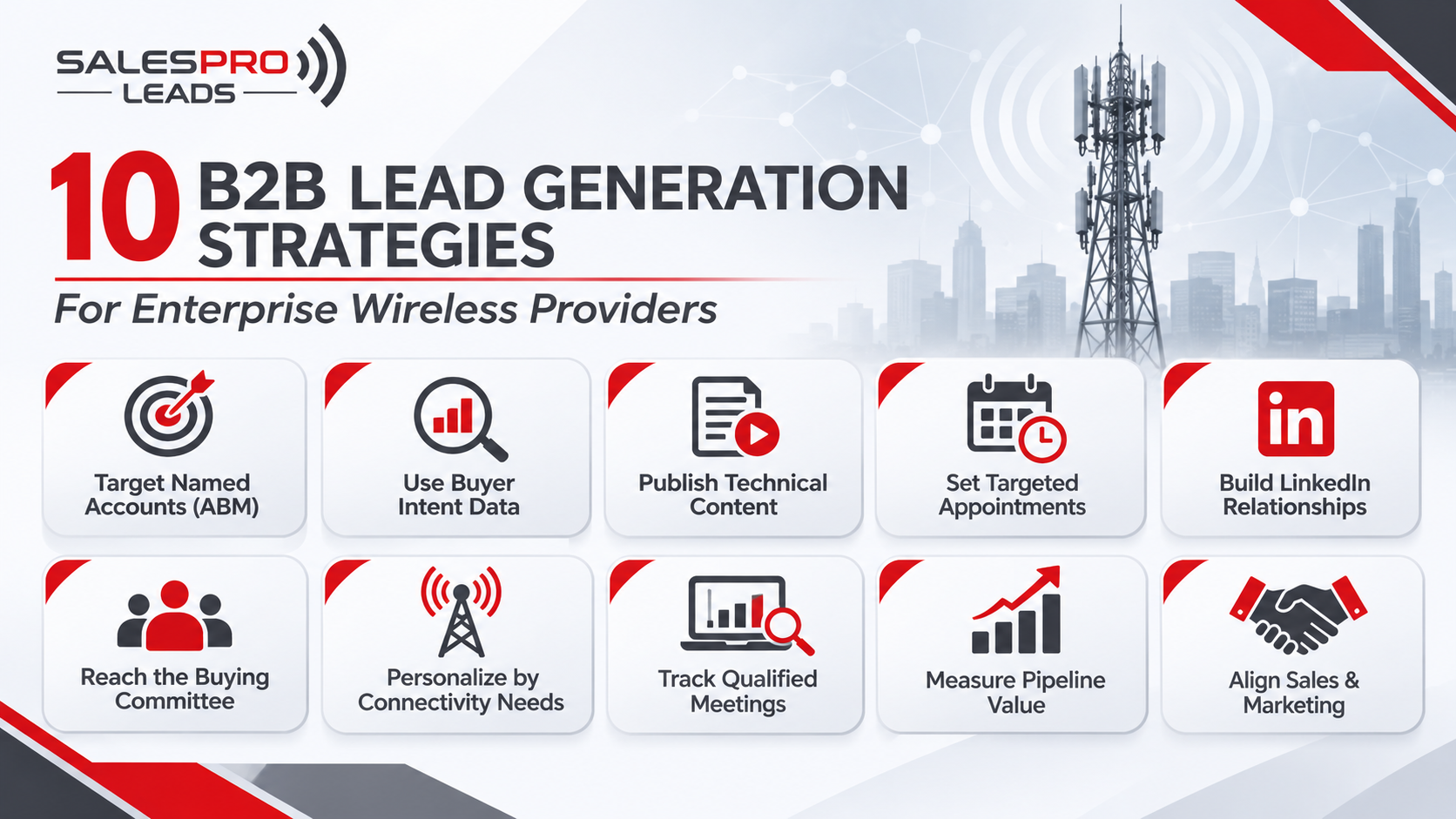
The most effective way to generate B2B leads for enterprise wireless providers is to combine account-based targeting with intent data and human-led outbound appointment setting. Identify the specific accounts that need reliable connectivity, use buying signals to find them at the right moment, and follow up with trained callers who can speak credibly to technical decision-makers. Support that outreach with content that answers real infrastructure questions and nurture relationships on LinkedIn. Providers who blend these tactics build a steadier stream of qualified leads than those relying on any single channel.
Measuring What Matters
Chasing raw lead volume is a common mistake. A high volume of contacts means little if they don’t lead to qualified opportunities. Track the metrics tied to revenue instead: qualified meetings booked, opportunities created, and pipeline value by account. When you measure the quality of your B2B leads rather than the quantity, you quickly learn which channels deserve more investment and which ones are quietly wasting your budget.
Feedback loops matter too. Ask your sales team which leads felt ready to buy and which fell apart on the first call. That insight sharpens your targeting far faster than any dashboard alone.
A Gap Most Providers Miss: Aligning Sales and Marketing Handoffs
Generating more leads is only part of the equation. Providers also need to make sure those leads move smoothly from marketing into sales. Plenty of wireless companies pour money into demand generation, then lose leads in the gap between marketing and sales. A promising contact goes cold because nobody followed up in time, or because the handoff lacked context about what the buyer actually wanted. Tightening that transition can improve conversion without requiring additional investment in lead generation. Agree on a shared definition of a qualified lead, set a response-time standard, and make sure every handoff includes the notes your reps need to pick up the conversation. It’s unglamorous work, and it pays off every quarter.
Frequently Asked Questions
What are the best B2B lead generation strategies for wireless providers?
The strongest approach combines account-based marketing, intent data, useful technical content, targeted outbound appointment setting, and relationship building on LinkedIn. The right mix depends on your target accounts, sales cycle, and available resources.
How long is the sales cycle for enterprise wireless deals?
It varies, but complex enterprise connectivity deals often run several months because they involve multiple stakeholders and formal procurement. That makes consistent follow-up and lead nurturing especially important.
Should we build lead generation in-house or outsource it?
A hybrid approach can work well. In-house teams can manage content and relationships, while a specialized partner handles outbound prospecting and appointment setting that requires trained callers.
How do we qualify B2B leads for enterprise connectivity?
Score leads on fit and intent: company size, industry, existing infrastructure, decision-making authority, and signals that they are actively researching a solution.
What content helps generate B2B leads for enterprise wireless providers?
Case studies, coverage and migration guides, security explainers, and honest comparison pieces perform best because they answer the technical questions wireless buyers actually ask.
Bringing It Together
Winning enterprise connectivity deals comes down to reaching the right accounts, engaging them at the right moment, and following through with people who can hold a credible technical conversation. The strategies above give enterprise wireless providers a repeatable way to build a pipeline of qualified opportunities rather than a pile of contacts that go nowhere.
If you’re ready to fill your pipeline with qualified opportunities, the team at SalesPro Leads can help you put these strategies to work. Contact SalesPro Leads or book a call today, and let’s build a lead generation program tailored to your enterprise wireless goals.